


29 January 2021
The FACSA-UJI Chair brings together renowned experts to highlight the value of wastewater as a way to improve prevention and public health in the SARS-CoV-2 pandemic.
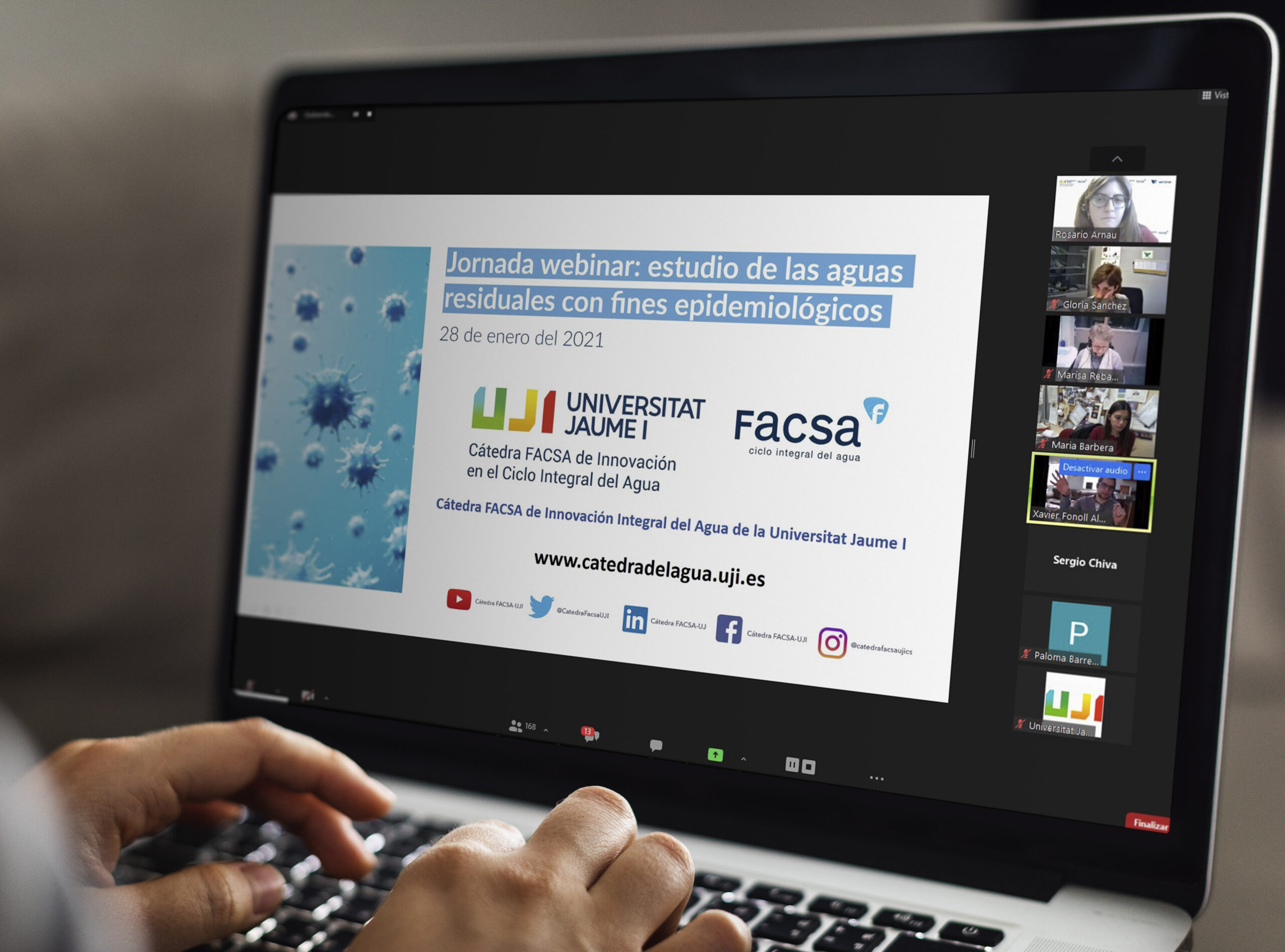
- More than 300 people attended the webinar, which included representatives from the public sector, the scientific community, and the business sector.
The Chair FACSA The Innovation in the Integrated Water Cycle department of the Universitat Jaume I held its first online conference entitled "Study of wastewater for epidemiological purposes," in which, before more than 300 attendees, the value of water residual as a source of resources and information.
The arrival of the COVID-19 pandemic, caused by the SARS-CoV-2 virus, has highlighted the need for early detection and alert methods to improve strategies for combating the epidemic. In this regard, the use of wastewater to anticipate potential outbreaks was emphasized during the conference, as was monitoring during active outbreaks by detecting the presence of SARS-CoV-2 genetic material in sanitation networks and wastewater treatment plants (WWTPs) in various locations. This presents wastewater as a means to improve prevention and public health.
As an example of the usefulness of this information, Núria Zamorano from FACSA's R&D department shared with attendees the main results obtained during the COVID WATER project. Co-financed with the Valencian Innovation Agency (AVI), "an intelligent platform has been developed that allows for the easy observation of trends in epidemiological indicators and information obtained from wastewater," she stated. The platform is already operational and is being used by numerous public administrations in more than 14 provinces, serving as an additional tool for decision-making.
Researchers from international organizations also attended the event, including Xavier Fonoll from the Detroit water agency, the Great Lakes Water Authority (GLWA, USA), who commented that "we are currently involved in several molecular biology projects at wastewater treatment plants (WWTPs), with which we hope this discipline will become a long-term component of wastewater treatment plant health control." He also presented the main results obtained in Detroit in collaboration with the prestigious Michigan State University (MSU).
The second speaker, Pablo Rasero, from the Seville Metropolitan Water Supply and Sanitation Company (EMASESA), offered the public sector's perspective at the national level, showcasing the early detection system implemented in Seville and the surrounding area. EMASESA acknowledges that monitoring genetic material in water is an expensive system, but undoubtedly more economical than mass screening. Pablo also emphasized the importance of "the rapid transmission of data from the laboratory to the health authorities.".
As expert researchers in the field, Gloria Sánchez, a researcher at the Spanish National Research Council (CSIC) within the Institute of Agrochemistry and Food Technology (IATA-CSIC), has been involved. Sánchez highlighted that "this type of analysis is capable of anticipating and indicating trends regarding the impact of the disease on the population. Furthermore, it allows us to study which variants of the virus are circulating within society," acknowledging the significant effort of numerous entities that have worked on standardizing the SARS-CoV-2 analysis protocol in water, in conjunction with the Ministry of Science and Innovation.
On the other hand, Juan Bellido and Marisa Rebagliato, along with Maria Barberá, from the Department of Epidemiology and Public Health (UJI), presented as an example the monitoring of the evolution of a Covid-19 outbreak in the city of Castelló de la Plana during June and July and its impact on wastewater. For this research group, "the results of environmental monitoring in wastewater were an additional tool that helped the research team determine the end of the outbreak in Castelló de la Plana in an anonymized and non-intrusive manner." This work highlighted the need for multidisciplinary teams of experts from the water sector, microbiology, and those who work daily with clinical data and epidemiological indicators of Covid-19.
The final speaker, Professor Félix Hernández from the University Institute of Pesticides and Water (IUPA-UJI), presented his extensive experience in Wastewater Epidemiology (WBE), focusing on drug abuse, and the most relevant aspects of this type of study. According to Hernández, "a population's wastewater is very valuable because it's a kind of fingerprint of how we live. What we need to find is a stable marker.".
Finally, during the debate session, topics of interest such as the impact of new variants and vaccination programs on this type of study were addressed.
This online event is part of the activities organized by the FASCA Chair of Innovation in the Integrated Water Cycle at Universitat Jaume I and its WATER UJI initiative, funded by the Valencian Innovation Agency. More information at: www.catedradelagua.uji.es.
Related news


Need help?
We are here for whatever you need