


7 June 2024
The XXXVII AEAS Congress concludes with a firm consensus on the need to promote a change in water management based on innovation and sustainability
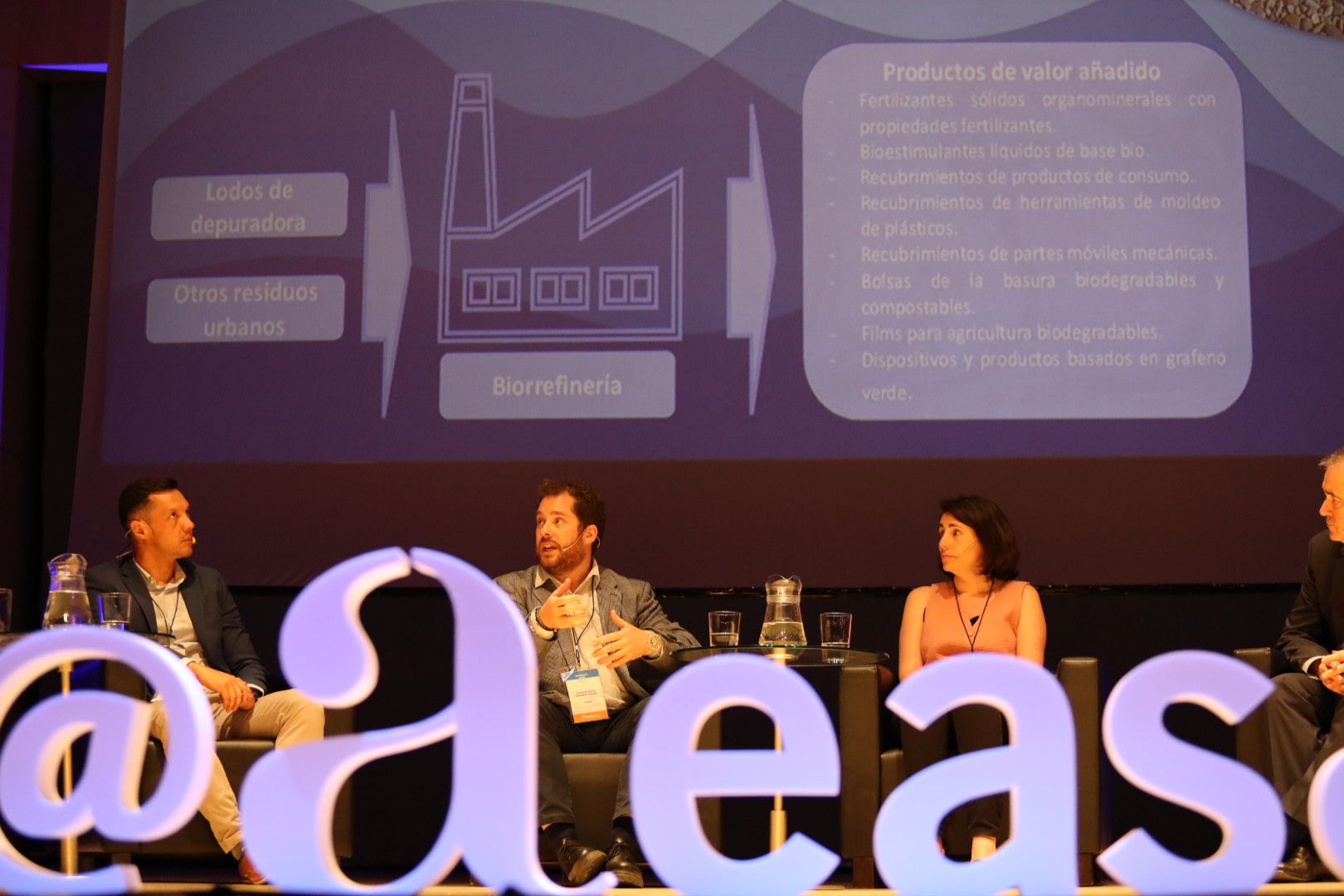
The AEAS Congress, held from June 5th to 7th, brought together leading experts and professionals from the water sector in Spain, becoming a key forum for the exchange of ideas and innovative proposals. Facsa, celebrating its 150th anniversary, hosted the event and played a prominent role in the various sessions. The company took this opportunity to address a wide range of crucial issues for water resource management and sustainability, underscoring its commitment to innovation and efficiency in the sector. The congress concluded this morning with the participation of María Dolores Pascual Vallés, Director General of Water at the Ministry for Ecological Transition and the Demographic Challenge (MITECO); Salomé Pradas, Minister of the Environment, Water, Infrastructure and Territory; Sabina Goretti, Director General of Water for the Valencian Government; and José Aparicio, Manager of EPSAR.
The opening presentations kicked off a series of discussions on the various challenges facing the water sector. José Claramonte, CEO of FACSA, presented ‘The water management model in Spain. Proposals for improvement’. Claramonte emphasised the need for a paradigm shift in water management, highlighting the importance of investment. His proposals sought practical and sustainable solutions to face current and future challenges. ‘We must face the current situation we find ourselves in. We are managers of water scarcity and we must adapt to that dynamic by making investments and carrying out projects that allow us to face the new challenges,’ stressed Claramonte. On the other hand, Gonzalo Delacámara, an economist who is an expert in the water sector and director of the Water and Climate Adaptation Centre at IE University, presented ‘Water and geopolitics: permeable borders between the local and the global’. Delacámara addressed the interconnection between local water management and global challenges, highlighting the importance of a holistic vision for tackling water issues in a globalised context.
During the congress, FACSA also highlighted the importance of leveraging remote meter reading data, a crucial issue for optimizing water supply management. They emphasized the need to develop advanced technological solutions and data quality models to improve the interpretation of results and maximize the efficiency of invested resources.
Regarding pollutant control, Ernesto Santateresa, deputy head of Environmental Quality Operations, together with Félix Ripollés of IPROMA-EUROFINS, presented ‘Presence of priority substances and other pollutants in sewerage networks’. Both experts discussed the evolution of pollutant control, pointing out that the monitoring of emerging substances such as pesticides and medicines is crucial for public health and the environment. Thanks to advances in analytical chemistry techniques, it is possible to identify and quantify very low levels of pollutants, which is crucial for EU regulations and the new Wastewater Treatment Directive currently being approved.
Another relevant topic was presented by Francesc Gavara, head of the Metrology Department, in his paper ‘Guide to obtaining consumption patterns’. Gavara emphasised that water scarcity and its high demand require that management companies be more demanding about water metering. Knowing the consumption pattern is crucial for planning demand and properly sizing distribution networks.
Likewise, Facsa addressed the creation of a geospatial digital twin for integrated water management, showing how digitalisation and GIS can transform the efficiency and sustainability of the sector. And in this context, Jorge Fuentes, head of the Information Technology and Operating Systems Department, presented ‘Waternology: a comprehensive digital strategy as a lever for sustainability in the integrated water cycle’. Fuentes underlined the importance of digitalisation as a key tool for mitigating the effects of drought and climate change. Facsa is committed to digitalisation to reduce water losses and optimise energy consumption.
Furthermore, the quantification of micronanoplastics in reclaimed water and agricultural ecosystems was analyzed, along with the development of a system of guarantees of origin for renewable gases and improvements in energy efficiency in water supplies in the province of Castellón. In this regard, a study was presented that identified potential energy savings of 20% in two water supply consortia, with the possibility of extending this methodology and tool to other municipalities to improve energy efficiency in their supply systems.
It is also worth noting that Guillermo Berlanga, head of the R&D&I and Continuous Improvement Department, took part in the round table ‘Innovation in the water sector. Where are we heading?’. Berlanga highlighted innovative projects, such as hydrogen generation, and how Facsa is working on these strategic initiatives for the future of water.
The congress also addressed the importance of digitalisation and disruptive technologies in achieving more efficient and sustainable water management. In this regard, Víctor M. Ferrando, head of Acquisitions and New Business, gave a paper entitled ‘Augmented reality and machine vision in the operation and maintenance of facilities’. On the other hand, Fco. Javier García, head of the Water Treatment Department, explained how the CYANOA project uses new technologies to improve water quality in reservoirs, mitigating the risks associated with cyanobacteria.
Finally, in the communication session, the importance of transparency and clarity in information related to water management was discussed, highlighting the need for effective communication in the sector.
In conclusion, the presentations given by Facsa at the AEAS Congress highlighted its dedication to innovation, efficiency, and sustainability in water management. The proposals and solutions presented not only address the sector's immediate challenges but also anticipate and prepare for future ones. This pragmatic and proactive approach demonstrates Facsa's ongoing commitment to creating a sustainable water future, where water preservation and responsible use are fundamental.
Related news


Need help?
We are here for whatever you need