


11 March 2022
LIFE AMIA already obtains 500 liters of purified water per hour at the Alhama de Murcia WWTP with low energy consumption
LIFE AMIA is a project that aims to promote the reuse of wastewater in treatment plants using low energy consumption technology and minimize the emission of greenhouse gases into the atmosphere, which was launched in 2019.
The technology validated in LIFE AMIA is a treatment that is carried out in three stages: a first compact anaerobic-aerobic (A2C) biological process that combines granular anaerobic biomass with an aerobic process with supported biomass; two microalgae reactors that receive the water from the previous aerobic process; and, finally, a tertiary treatment based on an advanced oxidation process that allows the elimination of micro-contaminants and pathogens, guaranteeing the quality of the treated water.
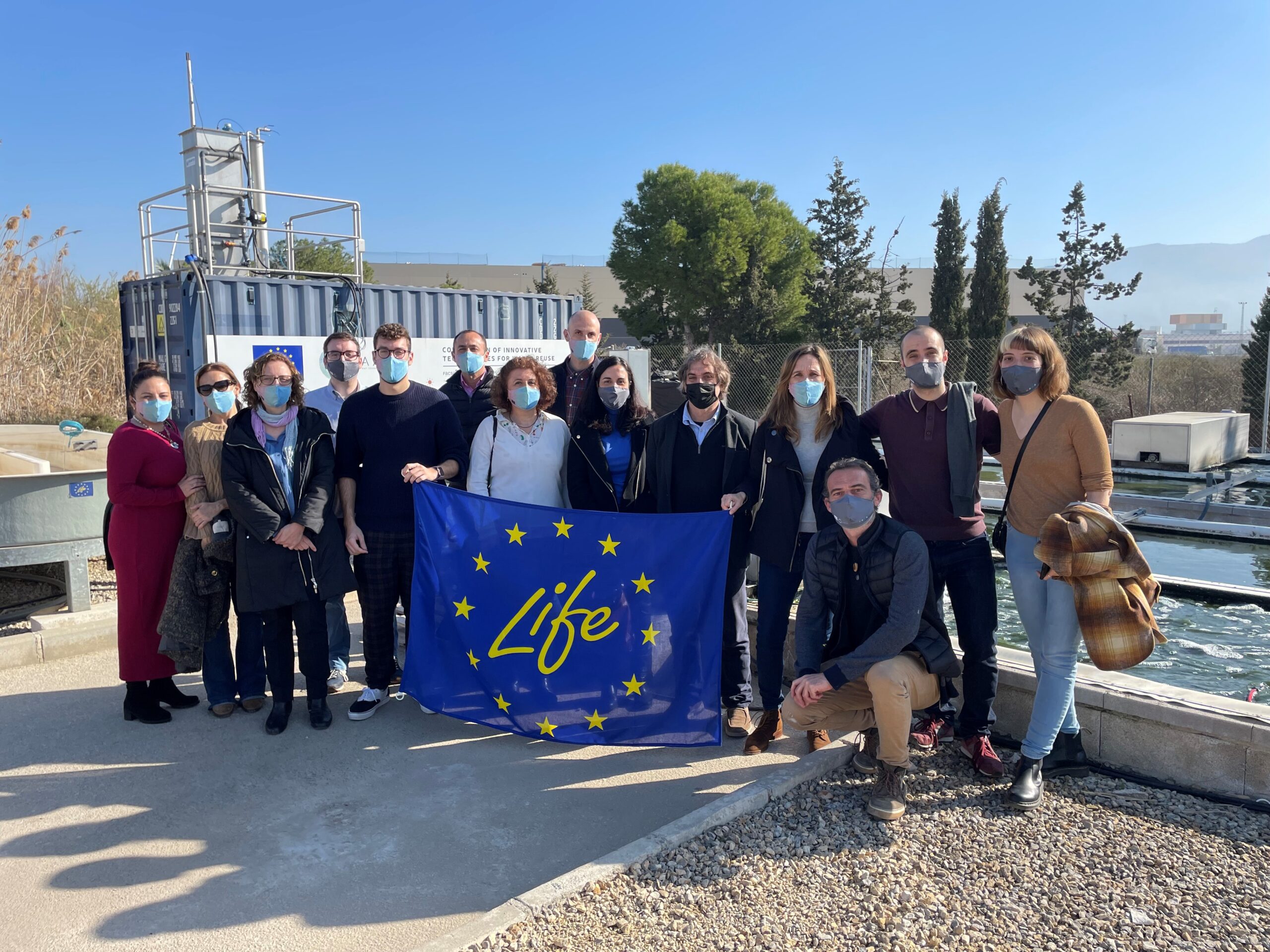
After 31 months of work, the project's progress has now been presented to Mariona Salvatella, monitor of NEEMO Life Team and person responsible for monitoring the programme of the European projects of which LIFE AMIA is a part. The presentation of the project's progress took place a few days ago; it began with a visit to the Alhama de Murcia WWTP, the treatment plant where the project is being carried out, and ended with a partners' meeting at the headquarters of the Wastewater Treatment Authority of the Region of Murcia (ESAMUR).
Advances and importance of reuse
Currently, the demonstration plant where the LIFE AMIA project is being carried out is operating at full capacity, with low energy consumption, obtaining 500 liters of regenerated water per hour and thus fulfilling the project's objective of improving the quality of purified water for its subsequent reuse in agriculture, since AMIA technology allows the elimination of pathogens and the reduction of micro-contaminants by more than 95% of their concentration.
Another objective that has been achieved is that it has been demonstrated that the sludge extracted from the treatment of wastewater, mixed with algal biomass (a powerful source of energy), is a good agronomic practice to be used as fertilizers in the greenhouses of CEBAS-CSIC, thus promoting the circular economy.
Water reuse is especially relevant considering that water stress currently affects 130 million inhabitants of the European Union (30%) and that, according to data shared by the United Nations, based on Sustainable Development Goal 6, by 2030, due to climate change, the availability of water for basic human needs will decrease and jeopardize access to drinking water and sanitation for millions of people.
Project partners and investment
The European LIFE AMIA project is made up of partners of various nationalities such as: the coordinator FACSA; ESAMUR; the Center for Soil Science and Applied Biology of the Segura of the Higher Council for Scientific Research (CEBAS-CSIC), the Eurofins Iproma laboratory, the British company Arvia Technology and the Cypriot consultancy Atlantis Consulting.
The project (ref. LIFE18/ENV/ES/000170), which has a duration of 40 months and a total budget of 1.945.914 euros, is part of the European LIFE Programme, a financial instrument of the European Union dedicated exclusively to the co-financing of projects in favor of the environment.
Related news


Need help?
We are here for whatever you need