


11 April 2024
iRAIN: Artificial intelligence for the reuse of wastewater and its nutrients in the agricultural sector
Currently, the demand for water continues to grow, and the pressure on water resources is increasing daily. To address this situation, it is essential to invest in new sources of supply, such as water reuse through wastewater treatment and regeneration processes.
For the use of treated wastewater to become a viable water resource, it is necessary to invest in the development of new technologies that allow the production of water with the necessary quality for its reuse in agricultural or industrial activities, and at the same time, that is economically viable and environmentally sustainable.
In this context, iRAIN was born, a project whose objective is to develop an innovative water resource management system through research into new systems and technologies to regenerate and reuse wastewater and its nutrients for safe agricultural use. This will be achieved through the application of advanced hybrid tools that combine monitoring and artificial intelligence by fusing data from satellites, drones, agricultural robots, and sensor networks.
FACSA, a company dedicated to the integrated management of the water cycle for 150 years, leads a multidisciplinary consortium created specifically for this project, bringing together 10 entities of diverse nature. These include companies such as Giditek (also part of the Gimeno Group), Aquacorp, Azud, Airbus, Telespazio, Saltó, and Akis; and two Technology Centers, EURECAT and CATEC, which guarantee the necessary knowledge transfer to achieve the disruptive innovations proposed in the iRAIN project.
As stated by the iRAIN consortium, "the purpose of iRAIN is to substantially improve the management and use of wastewater, combat water scarcity and maximize the profitability and efficiency of both reuse practices and regenerated and recovered resources."
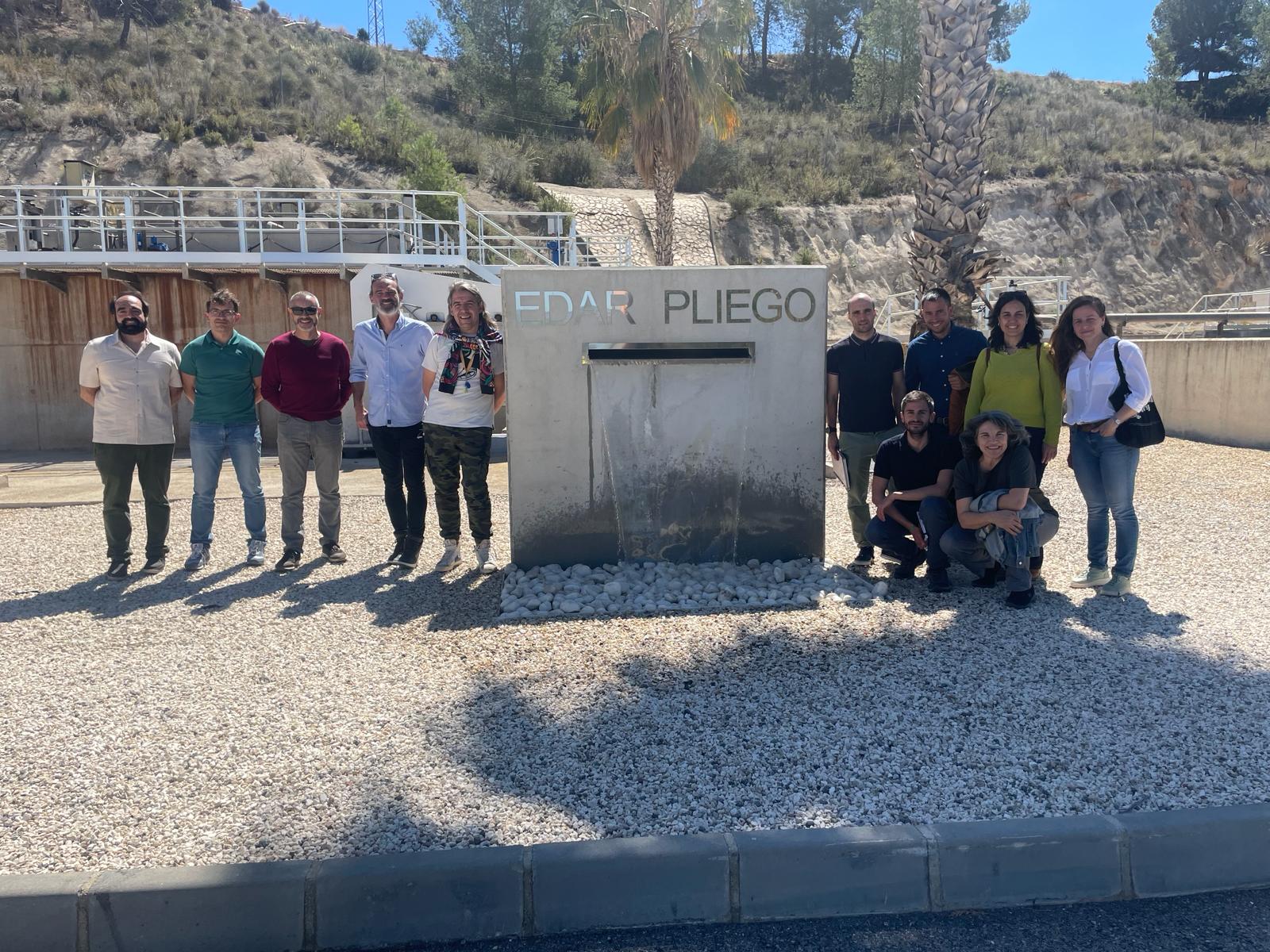
Representatives of all these entities met at the Pliego wastewater treatment plant and at the facilities of the Pliego Irrigators' Community, where a large part of the activities of this innovative project will be carried out. During the meeting, attendees analysed the project's work plan, which has been divided into four activities (three of industrial research and one of experimental development).
The first activity will focus on researching water regeneration and nutrient recovery techniques for agricultural use, while the second will investigate advanced techniques for monitoring water quality and crop health. The third will study and design digital solutions for the combined and optimized management of wastewater treatment plants with tertiary treatment and reclaimed water management, exploring different uses for their effluent, including fertigation. Finally, the fourth activity will evaluate the improvements and impact through validation in realistic environments.
This project is part of 'TransMisiones', an initiative of the Centre for Technological Development and Innovation (CDTI) and the State Research Agency (AEI) which coordinates funding for groups of companies and groups of research and knowledge dissemination bodies that collaborate for the joint development of a coordinated R&D action, which responds to environmental challenges such as the optimization of water management.
The CDTI, a Public Business Entity dependent on the Ministry of Science, Innovation and Universities, supports this project through a grant of 2.060.186 euros and from the AEI, an entity also dependent on the Ministry, this project (PLEC2023-010205) receives 1.753.158 euros of funding (MICIU/AEI /10.13039/501100011033).

Related news


Need help?
We are here for whatever you need