


9 July 2021
FACSA will showcase its latest advances in odour management at the IWA Odour & VOC/Air Emission Conference international congress in Bilbao
Next October, Bilbao will host the ninth international congress IWA Odour & VOC/Air Emission Conference on odour and volatile organic compound (VOC) emissions, organised by Olores.org and the International Water Association (IWA). An important event at which FACSA will be present with four innovative studies on the dispersion of odours and VOCs at WWTPs.
In this way, the R&D&I team of FACSA will share with attendees its commitment to the assessment, innovation and modelling of these emissions at its facilities. This work is carried out in order to reduce them and to justify the origin of air pollution to the public. This issue is drawing the attention of WWTP managers in Spain, who see how constant population growth means that plants built on the outskirts of cities are gradually being absorbed by metropolitan and industrial areas, with the problems that this entails.
In this regard, a very important part of controlling this type of atmospheric emissions is the monitoring and characterisation of the emission sources. In relation to this aspect, FACSA will present the results of work focused on monitoring odorous compounds using the Vigi eNose system (Chromatotec, Fr.). This equipment continuously analyses odour and VOC concentrations at a WWTP at five emission sources and one additional point. In a first study, this equipment has proved to be very sensitive and to give results equivalent to other analytical methods, showing the most relevant compounds in the emission of odorous compounds at this WWTP.
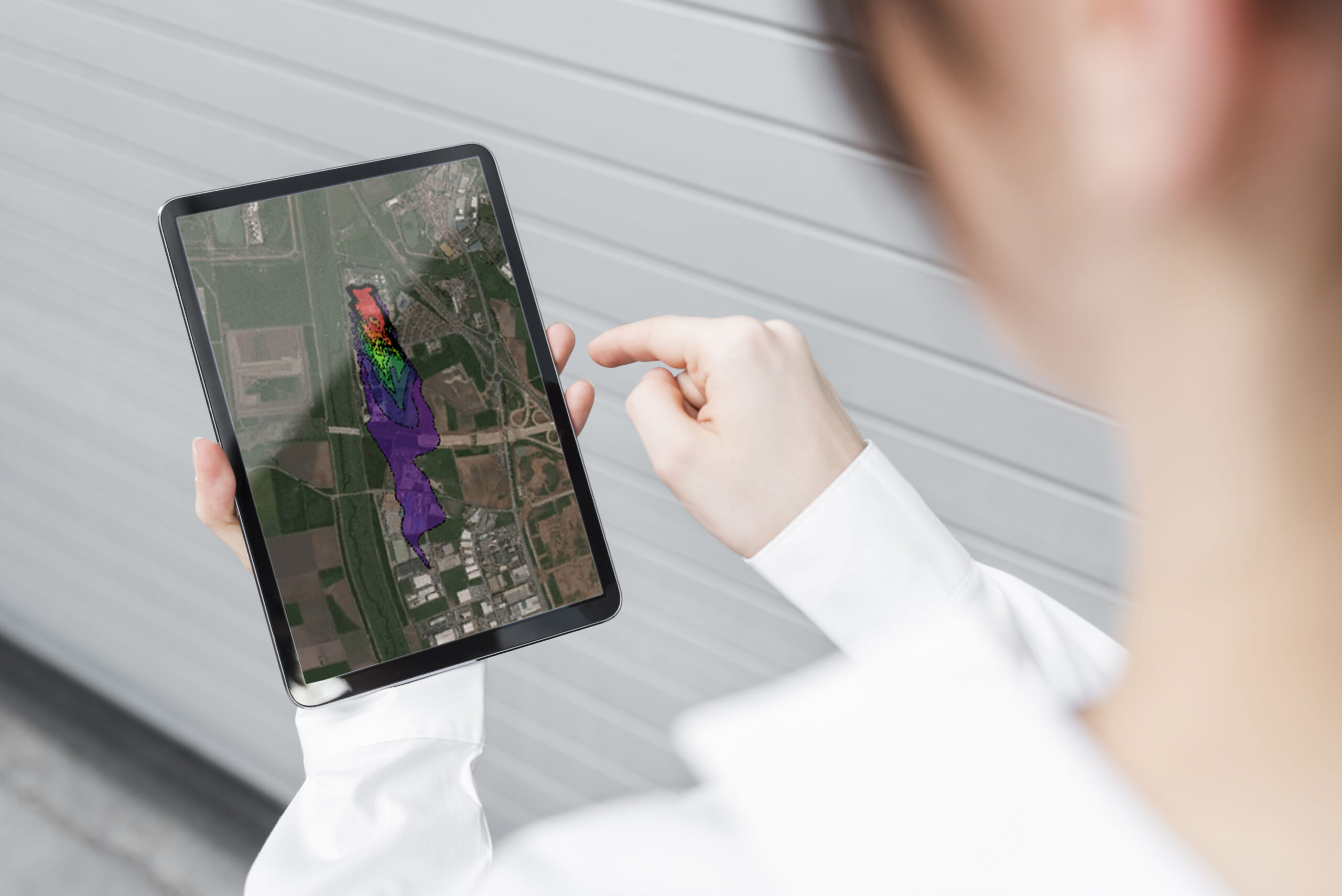
On the other hand, modelling the dispersion of atmospheric pollutants is currently a recognised technological resource for better understanding the range of impact generated by odorous compounds emitted at WWTPs. These tools must be fed with quality meteorological data and information on the emission sources. For this reason, in a second study the CALPUFF dispersion prediction model and the WRF-ARW weather research and forecasting system have been coupled to the Vigi eNose system mentioned above. Integrating the analytical results of the Vigi e-Nose equipment into the WRF-CALPUFF dispersion system has made it possible not only to implement a near real-time odour dispersion modelling system, but also to improve odour dispersion predictions.
With regard to odour dispersion models such as CALPUFF, a third piece of work will be presented in which a new odour measurement methodology has been developed using scenario diagnosis. To achieve this, the emissions of different process units of the WWTP have been characterised independently. In addition, the emission from the primary settling tanks has been differentiated between their surface and their perimeter channel. These data have been entered into the CALPUFF model and different scenarios have been simulated with different corrective measures applied to the emission sources. In this way, the results of the different scenarios make it possible to quantify the odour reductions achieved depending on the corrective measures adopted in each scenario.
As regards odour dispersion models with high spatial resolution, a fourth piece of work will be shown that proposes Computational Fluid Dynamics (CFD) models as a practical tool to support this type of modelling. This work is led by the Multiphase Fluids Group of the UJI in collaboration with FACSA. Urban microscale CFD simulation has made it possible to study non-homogeneous odour dispersion due to the configuration of the urban canopy. This type of model is really useful for detecting different regions of high turbulence (for example, around buildings) that could give rise to intense odours.
Related news


Need help?
We are here for whatever you need