


20 February 2023
Facsa reinforces its commitment to Augmented Reality and sensor technology for facility maintenance and remote assistance
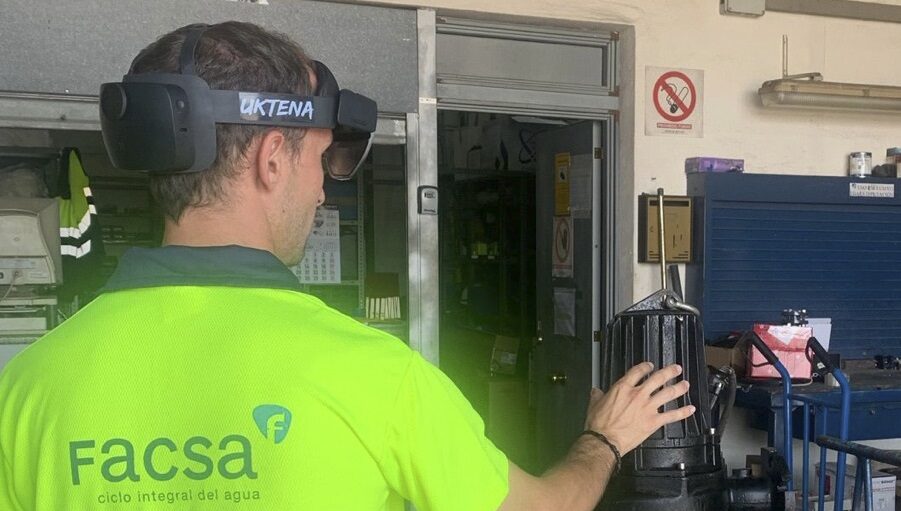
- The company has designed and developed remote assistance modules, work orders, automatic report generation, and data visualization that are executed by personnel using AR glasses in maintenance tasks.
- Experts agree that technology and digitalization will lead to an improvement in the processes and systems of the Integrated Water Cycle and will be key to facing the new challenges of the water sector.
FACSA shared its expertise in developing new technologies for the maintenance of integrated water cycle facilities at the Water Sector Maintenance Forum, held in Bilbao, which, according to the organizers, brought together more than 200 experts. During the event, organized by the Spanish Maintenance Association (AEM), along with the Spanish Association of Water Supply and Sanitation (AEAS) and the Bilbao Bizkaia Water Consortium (CABB), Malú Barrera, Facsa's acquisitions and new business specialist, highlighted Augmented Reality as a novel technology "very useful in integrated water cycle maintenance tasks, offering advantages such as remote assistance and access to real-time information," she stated.
In his presentation entitled “Application of Augmented Reality to maintenance in Integrated Water Cycle facilities”, Barrera explained that to demonstrate the advantages of applying this technology to the tasks of maintenance personnel, the company has designed and developed remote assistance modules, work orders, automatic report generation and data visualization that have been validated by Facsa personnel using Augmented Reality glasses in their maintenance tasks.
On the other hand, Isabel Tormos, Head of R&D&I Projects at Gimeno Group, also gave a presentation in which she delved into the use of DTS (Digital Transformation System) to detect infiltration in sewers. Specifically, Tormos presented a study conducted by Facsa that sought to determine the cause of an increase in the influent flow to the Pola de Allande Wastewater Treatment Plant (WWTP) in Asturias during periods of flooding of fields for pasture growth. "The application of the DTS technique, in this case, demonstrated that the studied sewer showed significant water infiltration at different points and that, furthermore, the wells were also points of entry for water into the sewer," she emphasized.
Experts have agreed that the demanding challenges facing the water sector cannot be overcome without maintenance strategies, accompanied by technologies that employ the best available techniques, both current and future, and a greater degree of digitalization in facilities, processes and systems, making them safer and more efficient.
Related news


Need help?
We are here for whatever you need