


14 July 2021
FACSA celebrates the III Castellón Water Forum, which focuses the debate on water as a lever for recovery
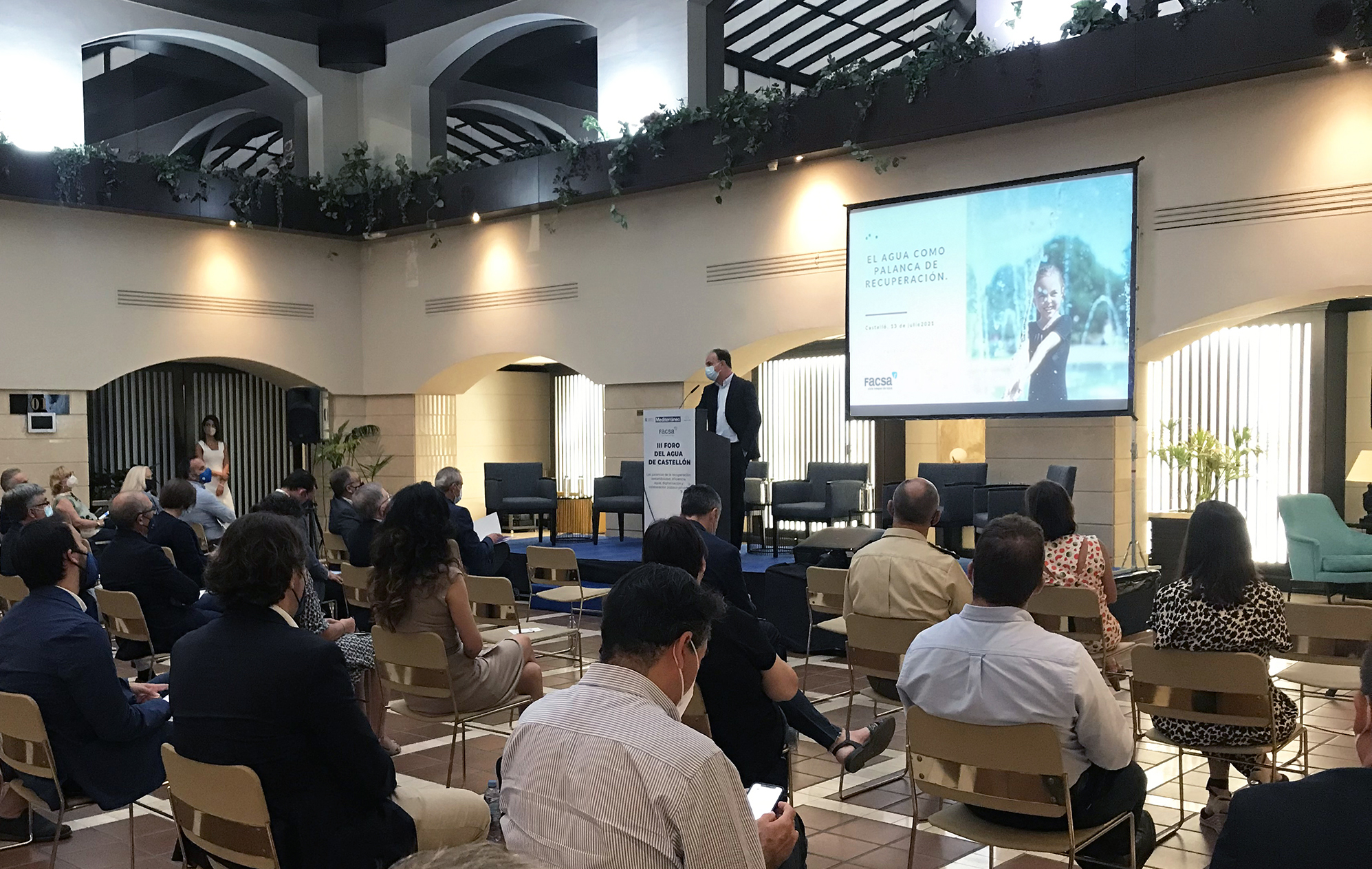
The Intur Hotel in Castelló hosted the 3rd Castellón Water Forum yesterday, an event organized by the Mediterráneo newspaper and sponsored by FACSA. The theme of this edition revolved around ‘The levers of recovery: sustainability, efficiency, water, digitalisation and public-private collaboration’.
The opening of the day's events was led by the president of the Valencian Generalitat, Ximo Puig, and the mayor of the city, Amparo Marco.
In his speech, Puig stated that «water is not only a strategic asset for industry, tourism or agriculture, and even more so in deficit areas», going on to assert that «it must be understood as a matter of State policy», in whose debate «there can be no winners or losers, because we all lose».
He also called for a global and urgent «response» to the «environmental challenge», with water resources at its core, formulated «from the local level” but carried out jointly by all levels of public administration and with the necessary complement of public-private collaboration. A response that, in terms of water management, must be «collaborative, sustainable, inclusive, incremental and structuring», translating into «sanitation, proper water management and new circular economy models».
Along these lines, the president detailed the key aspects of the Generalitat's water strategy, which he outlined in points such as the digitalization of water management; energy efficiency; the modification of bidding procedures, including the requirement of technological innovation; and the incorporation of local micro-enterprises and SMEs in water treatment.
For her part, the mayor of Castellón, Amparo Marco, described the General Plan as a key tool for the sustainable management of water. Indeed, «the new urban plan provides for saving measures that include more efficient supply systems, leak reduction or the reuse of rainwater and treated water for non-potable uses, as well as separate rainwater systems in all new development areas».
Next, the Director General of Coordination of Government Action of the Valencian Generalitat, Juan Ángel Poyatos, explained the key aspects of the Valencian recovery strategy, outlining the lines of action around five major strategic axes: employment, knowledge and research; economic resilience and digital transformation; ecological transition and territorial cohesion; care for people and social inclusion; and regional governance and efficient administration.
The second conference of this third edition of the Castellón Water Forum, entitled Water as a lever for recovery, was given by the general manager of FACSA, Jose Claramonte, who defended the role of water as an essential element for socio-economic development and the need to provide all the necessary resources to guarantee a more efficient management of it and to face the challenges that will lead us towards a sustainable future.
Following a brief overview of the water situation in the province of Castellón, Claramonte emphasized the need to invest in research and innovation to implement the best available techniques, from digitalization to the adoption of new, more efficient and sustainable technologies across all processes. She also stressed the importance of maintaining an asset inventory to facilitate the management of infrastructure, as well as the crucial funding required to undertake this transformation and ensure the continued quality of service and the sustainability of the resource.
To conclude the day, a round table discussion was held with the participation of speakers Juan Ángel Poyatos and Jose Claramonte, the mayors of Peñíscola (Andrés Martínez), Vall d'Uixó (Tania Baños), and Benicarló (Xaro Miralles), and the president of the Spanish Association of Water Supply and Sanitation, Fernando Morcillo. They exchanged views on sustainability as a cornerstone of recovery, digitalization as a key factor for the present and future, and the need for public-private partnerships to achieve the development goals set for the province.
Related news


Need help?
We are here for whatever you need