


20 January 2021
FACSA begins testing the Piver project to reduce the impact of industrial discharges into rivers
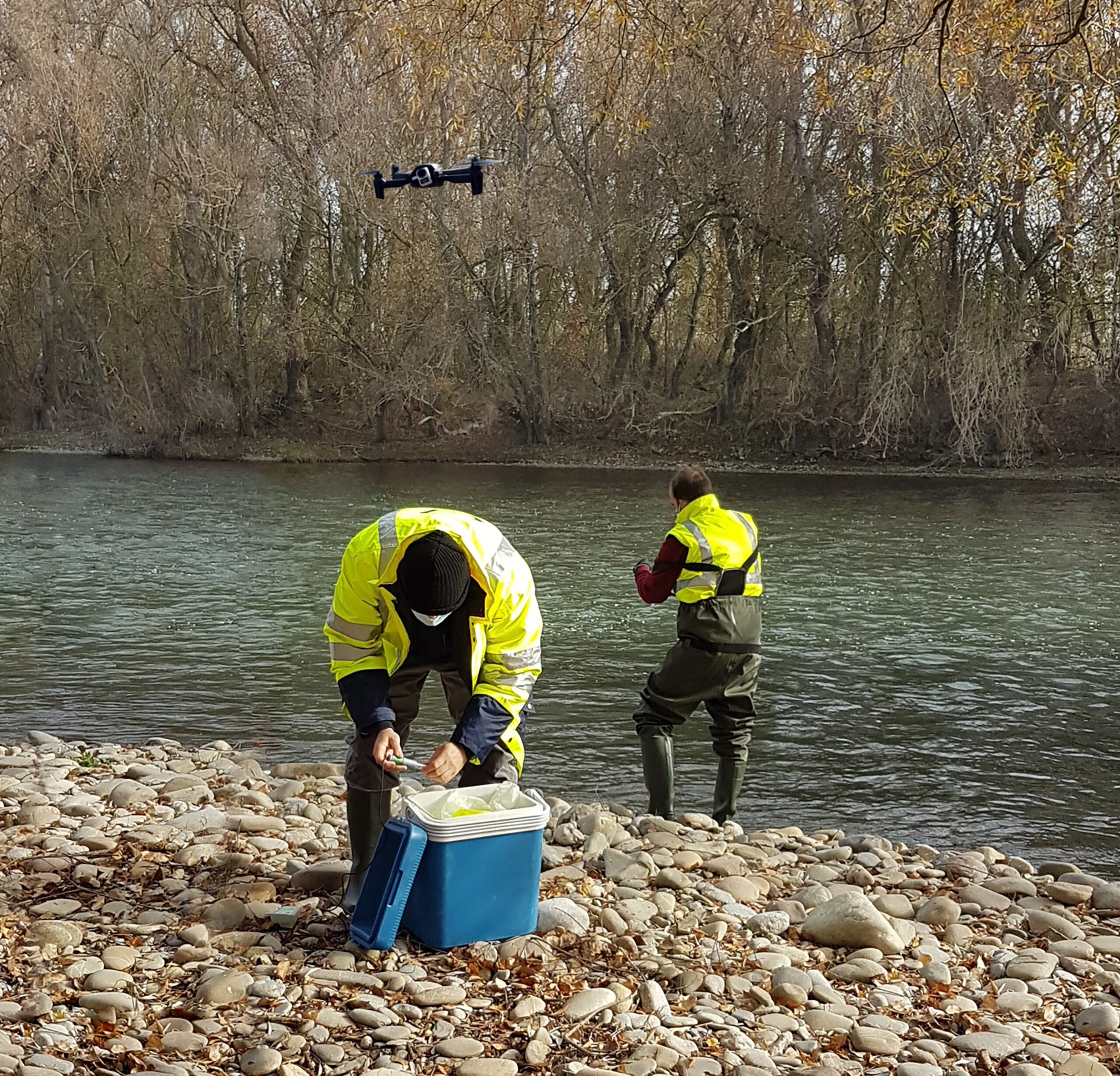
- The initiative is a collaboration between Ideya, Control 7 and Zinnae and has been subsidized by the Ministry of Industry within the latest call for aid to Business Groups or clusters.
- Its development is using a novel computational fluid simulation tool, as well as sensors and drones with thermal imaging cameras.
Developing an economically viable technology to measure and reduce the impact of discharges into riverbeds is the main objective of Piver. This project, driven by FACSA and subsidized by the Ministry of Industry, has already begun taking the first samples from the Aragón River in Navarre and the Gállego River in Zaragoza.
This initiative will make it possible to measure the dissolution of wastewater discharged into rivers, assess its impact on riverbeds, and propose corrective measures. This is all thanks to the work carried out by FACSA, Ideya, Control 7, and Zinnae, with the collaboration of the Ebro River Basin Authority. FACSA will contribute its expertise in two-dimensional hydraulic calculations and computational fluid dynamics (CFD), while Ideya will validate the models obtained using cutting-edge technologies such as sensors and drones with thermal imaging cameras, and Control 7 will lead the analysis of the discharged water.
Specifically, the sensors and drones will collect data that will then be verified by the innovative CFD tool developed by FACSA. The results will be compared with those obtained from water samples analyzed in laboratories. This will allow for more efficient intervention, enabling the discharge to be carried out differently or at different points to minimize its impact.
The development of this project—for which the Aragonese water cluster (Zinnae) has secured a significant grant from the Ministry of Industry in the latest call for aid to business groups or clusters—will reduce environmental risk and the economic costs associated with damage to the physical environment and ecosystems, providing financial guarantees to companies that produce the discharge. Likewise, it will offer river basin authorities a tool to support discharge inspections and define sampling points.
Related news


Need help?
We are here for whatever you need