


5 December 2022
Facsa analyzes the challenges Ibiza must face to achieve a more efficient water system
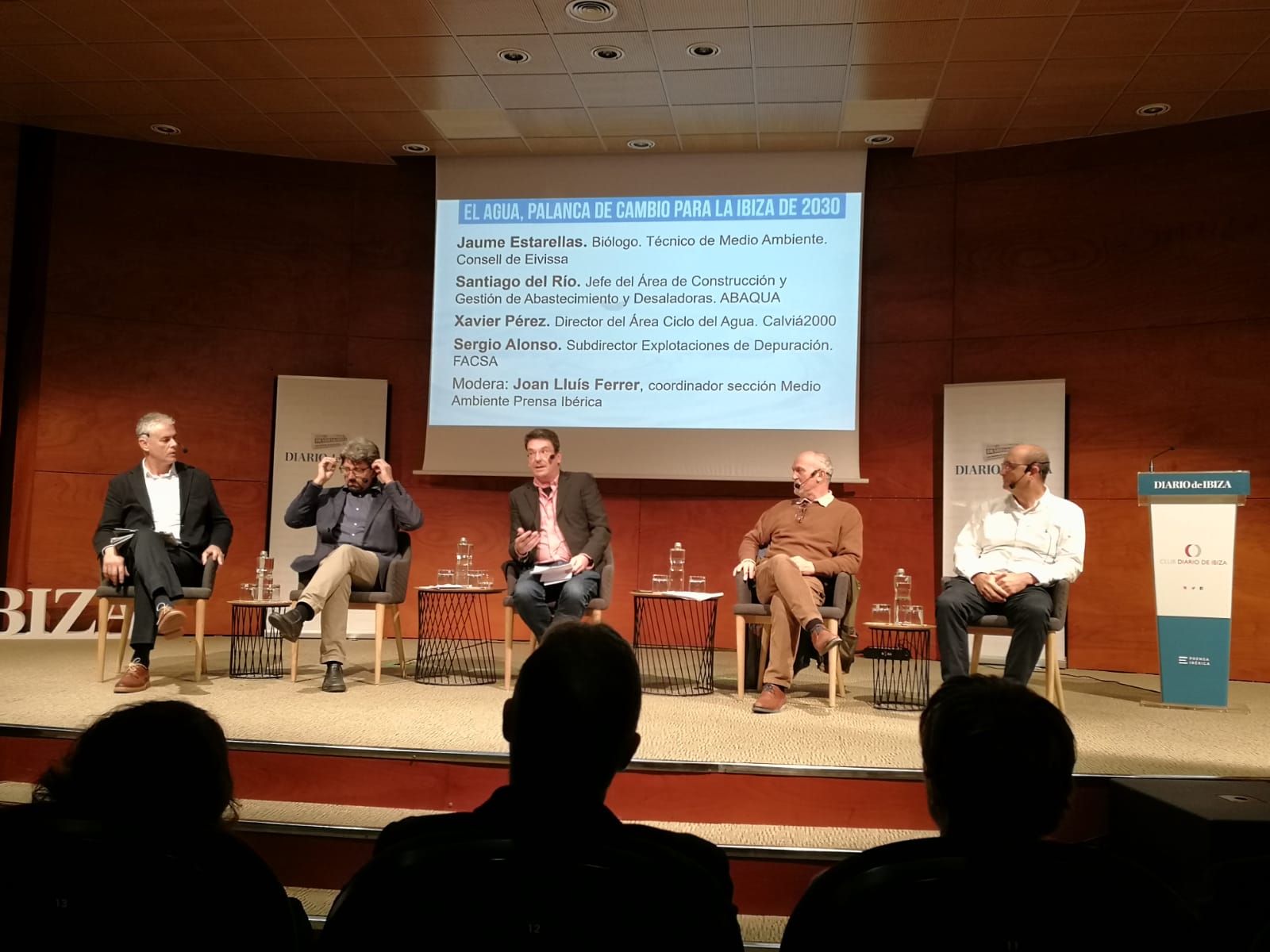
Controlling the population increase during the summer months, reusing treated wastewater, upgrading an outdated network, and raising awareness about the importance of reducing consumption are the main challenges for improving the water system in Ibiza. This was the conclusion reached by the speakers at the event 'Water, a lever for change for Ibiza in 2030,' in which FACSA.
The event began with a welcome from Rafa Ruiz, mayor of Ibiza, who recalled that, on the island, in summer, “the tap is often about to run dry” because of demographic pressure. “The island and the city of Ibiza are reaching limits that are not sustainable”, he stressed.
Next, the impact of climate change on water management was the focus of the presentation by Enrique Cabrera Marcet, Professor Emeritus of Fluid Mechanics at the Universitat Politècnica de València, who highlighted the importance of implementing a circular model in water matters, “treat and reuse”.
Sergio Alonso, Deputy Director of Wastewater Treatment Operations of FACSA, participated in the round table of the meeting along with Jaume Estarellas, biologist and environmental technician of the Consell de Ibiza; Santiago del Río, head of the Construction and Management Area of Supply and Desalination Plants of Abaqua; and Xavier Pérez, director of the Water Cycle Area of the public company Calviá2000.
Alonso elaborated on the paradigm shift taking place in the field of water treatment. “Previously, we viewed wastewater treatment plants as dirty places; now we are transforming them into biofactories that can even be integrated into cities. This new concept of a wastewater treatment plant not only avoids negative impacts (no noise or odors) but also works toward a positive impact and is conceived as an environmental education complex. Furthermore, until now they were intensive energy consumers, but now they are self-sufficient and can even become energy producers.”
He also pointed out the need to take care of wastewater, saying, “The worse the water is when it arrives at the treatment plant, the harder it will be to treat. It is especially important to prevent salt from seawater from entering the sewers.”
It was undoubtedly an ideal opportunity for representatives from companies, public administrations and other experts to analyze all the challenges and pending issues of the island regarding the management and approach to the water cycle.
Related news


Need help?
We are here for whatever you need