


8 June 2021
EPSAR and FACSA develop a pioneering technology, unique in Spain, to increase the efficiency and sustainability of the sludge treatment process in wastewater treatment plants.
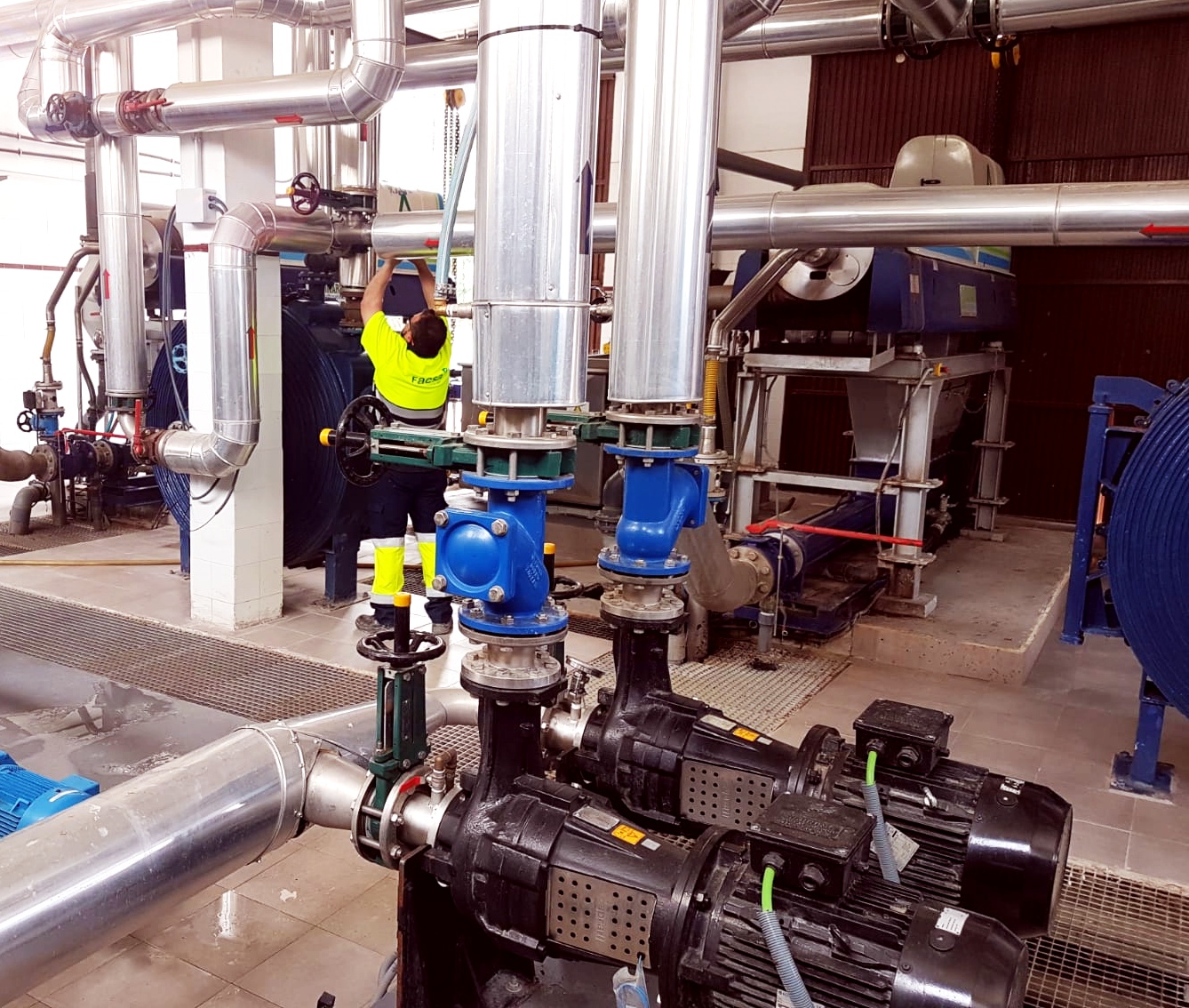
- This innovative commitment to the circular economy has allowed for a 20% increase in biogas generation at the Alcoy Wastewater Treatment Plant, significantly raising its levels of self-generation of electricity.
- This saving would cover the electricity needs of 425 households for a whole year, considering that the average household expenditure in Spain amounts to 290 kWh/month
- Thanks to two-phase temperature anaerobic digestion, the entities have also managed to reduce sludge production by 25,5% and thus the volume of waste
Aware of the opportunities presented by the use of wastewater and its by-products, the Public Entity for Wastewater Sanitation of the Valencian Community (EPSAR) and FACSA have promoted an innovative technology, unique in Spain, which significantly increases the efficiency and sustainability of the sludge treatment process carried out in Wastewater Treatment Plants (WWTPs).
To this end, a new operating model for the anaerobic digestion process, based on circular economy principles, has been implemented at the Alcoy Wastewater Treatment Plant. This model has a threefold objective: to reduce sludge production—and therefore waste—to maximize biogas production (a renewable equivalent of natural gas), and to attempt to sanitize the treated sludge.
The main innovation of the process lies in the application of two-phase temperature anaerobic digestion, thanks to which the sludge is heated to 55ºC, instead of 35ºC, in a smaller volume digester before passing to a larger one, where it is kept at a stable temperature of 35 degrees.
Thanks to the modification of the digestion process, sludge production has been reduced by 25,5%, and with it the volume of waste generated during the process, with the environmental benefits that this implies.
Similarly, in response to their commitment to the circular economy, EPSAR and FACSA have enabled a 20% increase in biogas production, boosting the station's self-generation of electricity and proving crucial for improving the facility's overall energy balance. These savings would cover the electricity needs of 425 households for an entire year, considering that the average household consumption in Spain is 290 kWh/month, according to IDEA sources.
This process has also made it possible to reduce the microbial load of the evacuated sludge by 90% for E. coli, or in other words, to reduce the microbial load of the evacuated sludge by two logarithmic units. While further testing is needed in this area, these data suggest the possibility of producing already sanitized sludge, minimizing its environmental impact.
Previous projects
The implementation of this innovative treatment has been made possible thanks to the research work of two other projects that FACSA is working on: SLUDGE4ENERGY and LIFE STO3RE.
The first of these, SLUDGE4ENERGY, carried out by the FACSA and the Ainia technology centre, focused on piloting this new technological process in order to improve the sustainability of the treatment process by optimising energy generation from renewable sources, thereby avoiding the consumption of fossil fuels and the CO2 emissions associated with their use.
With the second of them, LIFESTO3RE, the company sought to validate this new anaerobic digestion concept on a larger scale, designing a joint, energy-sustainable management system for sludge from WWTPs and pig slurry from farms, in order to obtain a high-quality «biofertiliser» for the environment.
With all this, EPSAR and FACSA strengthen their commitment to green energy, thanks to the development and implementation of processes, technologies and new equipment that improve energy efficiency, produce their own renewable energy and mitigate the ecological impact of our treatment systems.
Related news


Need help?
We are here for whatever you need