


25 September 2025
A report recommends tripling annual investment in water resilience to €6.000 billion
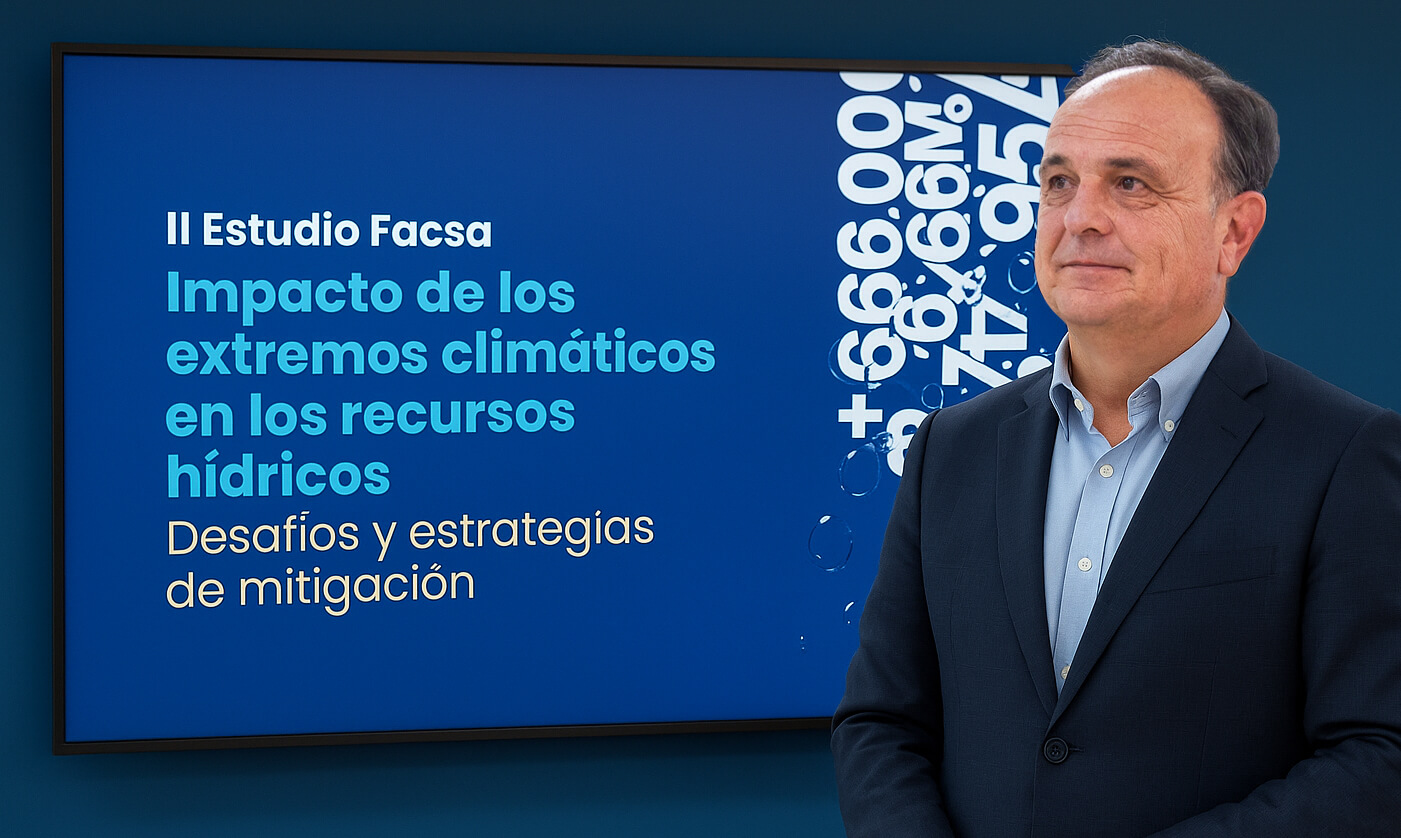
FACSA has presented its second study on the impact of extreme weather events on water resources, prepared in collaboration with Red2Red. The document underscores that the increase in extreme weather events—prolonged droughts, torrential rains, heat waves, and floods—represents one of the greatest challenges of the 21st century for water management. These events affect both water availability and quality, altering ecosystems and jeopardizing critical infrastructure and key sectors such as agriculture, industry, and tourism.
The report highlights that Spain is among the most vulnerable regions in Europe, with an increasing frequency of extreme events. Droughts have intensified in duration and severity, while torrential rains, although less frequent, are becoming more intense and destructive. Without ambitious adaptation measures, forecasts point to a progressive decrease in water availability and an increase in exposure to droughts, with serious impacts on agriculture, urban water supply, and ecosystem services.
According to the Global Commission on the Economics of Water, if no action is taken, Spain could lose up to 8% of its GDP by 2050 due to the water crisis, amounting to more than €136.000 billion. However, investment in resilient infrastructure could reduce projected losses by between 40% and 65%, according to the World Economic Forum. Thus, tripling annual investment in water resilience to €6.000 billion would prevent an economic impact of €88.400 billion in the coming years.
In this vein, Facsa warns about the costs and impact of inaction in the face of extreme climate risks. Between 2000 and 2019, climate disasters generated global losses exceeding $2,97 trillion. In Europe, these losses could surpass €170.000 billion annually if adaptation measures are not intensified. In the case of Spain, the National Climate Change Adaptation Plan (PNACC) and the European Environment Agency (EEA) estimate that extreme weather events—especially heat waves, floods, and droughts—have resulted in a cumulative cost exceeding €95.000 billion up to 2023.
Keys to strengthening water resilience in the face of climate extremes
The report identifies three key pillars for strengthening water resilience to climate extremes. First, technological solutions, including improved monitoring systems, digitalization of networks, and innovation in water treatment and reuse. Second, policies and governance, encompassing the integration of climate risk into land-use planning, the promotion of intersectoral cooperation, and the strengthening of regulatory frameworks. Finally, nature-based solutions, enabling the restoration of river ecosystems, the protection of wetlands, the promotion of aquifer recharge, and nature-based urban design.
“Adapting to extreme weather events must become a central pillar of water policy. It is imperative to act proactively, based on robust scientific knowledge and flexible planning tools. Prioritizing investments in water resilience will not only reduce future damage but will also generate sustainable social, economic, and environmental benefits,” emphasizes José Claramonte, CEO of Facsa.
Among the main recommendations, the Report points to the review and updating of hydrological plans to incorporate climate change scenarios, the strengthening of existing infrastructure to make it more resilient to climate extremes, the implementation of automated and interoperable early warning systems, the promotion of public participation and equity in access to water, as well as the promotion of international cooperation, especially in shared basins.
“Spain has the responsibility and the opportunity to lead water adaptation in Europe. Addressing climate extremes is not only an emergency, but also an opportunity to transform the water management model towards more sustainable, equitable, and future-proof systems,” concludes José Claramonte.
You can download the report at the following link: https://elaguaprimero.com/informe/estudio-2025/
Related news


Need help?
We are here for whatever you need